 Some views of Gwangan Beach in Busan. Gwangan Bridge is in the background. Koreans don't really swim, they just wade out into the water or float on tubes. If you notice, all of the tubes look the same. As do all of the umbrellas. That's because you have to rent them. 5,000 Won for an umbrella, 3,000 Won for a little mat to sit on, and 3,000 Won for a tube. The other thing you might notice is that many of the people aren't wearing swimsuits. Seems that they just prefer to wear their clothes into the water, even if they have a swimsuit on underneath.
It was crowded, but not as crowded as I thought it would be. Then again, this is the less popular beach. Haeundae Beach is where most people go to. 
Showing posts with label Korean culture. Show all posts
Showing posts with label Korean culture. Show all posts
Thursday, July 31, 2008
The Beach


Tuesday, May 13, 2008
Buddha's Birthday
Buddha's Birthday is a national holiday, so I headed to Busan to check out some of the festivities. The temples hang paper lanterns all over the place, I visited two previously seen temples and a new one as well.
Haedong Yonggung-sa
The first temple I visited was Haedong Yonggung-sa. It is located on the coast, with a dramatic vista. It's a bit of a ways from central Busan. If anyone reading this decides to go there, take bus #181 from Haeundae Station. None of the buses the on-line tourist information recommends get quite as close.

Samgwang-sa
Next in line was Samgwang-sa. This is my second visit to this temple. Lots of lanterns and a wide range of concessions to buy. 
Beomeo-sa
Also my second visit to this temple. I arrived there as night was falling, which appears to be the best time to go. The lanterns were being lit and there was a large crowd participating in the festivities. The little road up the mountain was so overtaxed that it was faster to walk. 

Sunday, April 27, 2008
Gimhae Gaya Culture Festival
 Another festival, this one a bit closer to home. Gimhae hosted the Gaya Culture Festival for one week. It was actually a pretty good festival, and I regret not spending more time there. They had a wide variety of entertainment, a decent food selection, and a various craft activities for the children. Although there were a few Korean twists that you wouldn't normally see at a festival in the States. For example, the hand acupuncture booth which was doing good business. I did spend a few hours getting paid to walk around and speak to people in English. Mainly school kids. After my shift, I managed to check out some of the closing activities.
One of which was a massive tug-of-war contest. The central rope stretched for a couple hundred yards. From this main rope radiated side ropes which people pulled on. To add to the effect, they had school groups dressed up in traditional Korean uniforms and groups of drummers in, what appeared to be, clown costumes. 
Here is some video footage of the actual tug-of-war and the post tug-of-war dancing.
After a couple of rounds of tug-of-war, the post battle celebration began. Cutting away a piece of the rope seemed to make for a valued souvenir. Unfortunately, I didn't bring a knife with me. Maybe next year. 
Sunday, April 13, 2008
Festival Weekend
Yeongdeok Snow Crab Festival
March seems to be the kick off of the Korean festival season, and I decided to take advantage and visit a couple of them. On Saturday, I went to the Yeongdeok Snow Crab Festival in, of course, Yeongdeok. Yeongdeok is famous for their crabs, with restaurants all over the country advertising Yeongdeok snow crab. The whole town is one giant string of crab markets and crab restaurants. As you can see, they take their crab seriously here.
It was an interesting festival, with some activities that required a little bit of explanation. Unfortunately, they were not prepared for the onslaught of English speaking tourists, namely myself, and did not provide any explanation whatsoever. One of the first things they did was some sort of silent auction. They had boxes of crabs and people wrote down prices. They held up their bid and the auctioneers went around selecting the winning bids. I don't think it was based upon the highest bid, but rather the closest to some randomly chosen magic price. I never did quite figure out the whole process, which is unfortunate since the prices seemed to be quite on the cheap side.
The next major activity was fishing for crabs. For 10,000 Won, about $10, you could rent a pole and catch crabs out of a giant pool they had constructed. But again, the directions in English were a little lacking. I was in line early for a pole, but unfortunately, it was the wrong line. I was in the line for those with tickets. But first, I had to buy a ticket in a line 5 feet away. Of course, they wouldn't just take my 10,000 Won and give me a ticket then and there. They wanted me to wait in line. Which had grown considerably longer by this point in time. So I gave up my hopes of catching my lunch.
And what could a crab festival be without eating some crab? So I headed to the food stalls were I first had to buy the crab from a vendor. Two good size crabs cost 50,000 Won, or about $50. Which is supposedly about half the price you'd pay in a restaurant. They then had cookers who I had to pay 6,000 Won to cook my crab. As you can tell from the before and after pictures, the crabs were quite tasty. For another couple thousand won, they even took the bodies and mixed in some rice with the innards. So pretty much every last edible bit of those things was consumed.
Before
After
Cheongdo Bullfighting Festival
(official website in Korean)
From Yeongdeok, I headed to Daegu, where I spent Saturday night. On Sunday morning, I was off to Cheongdo for the bullfighting festival. You may remember that attended this festival last year as well.
The forecast was for rain, but it ended up being a beautiful day. The stands were crowded and the bullfights were as fascinating to watch as they were last year. There was even a woman trainer who won her match, which excited the the crowd, especially the women.
I was able to take some better video this year as well, but I still need to edit it down. So check back in a week or two for that. 

Tuesday, April 1, 2008
Korean Ages 201
After over two years here, I have finally uncovered the full secret to Korean ages.
When a baby is born, they start out at the age of 1 year.
If they celebrate their birthday according to the lunar calendar, which is rare these days, but a little more common among older Koreans, they age another year on Lunar New Year's Day. Which is in late January or early February of the solar year.
If they celebrate their birthday according to the solar calendar, they age another year on Solar New Year's Day. Which is, of course, January 1.
You can convert to lunar dates at the Hong Kong Observatory web site.
Saturday, October 13, 2007
Korean style
For a change of pace, I'm introducing a new game. Figure out how many cops and security guards it takes to direct traffic at this intersection. 
Now on to the fun.
Fishing, Korean style
I suppose when most people go fishing, they just want to relax and get away from the crowd. Compared to most places in Korea, I suppose this counts as "getting away." 
Fishing Village, Korean style
As if Sorae wasn't crowded enough, they've started on another 20 building apartment complex. I'm guessing this place was home to about 5,000 people not too long ago. Within the next 5 years, the population will probably be well over 50,000. I love checking out the market from the bridge. Going into the market is a nightmare. 
Village Police, Korean style
An astute eye might say that there are 9 cops and security guards directing traffic at this intersection. In reality, there are another five supervisors / back-ups located off camera to the left. So the correct answer is 14. 
Sunday, March 25, 2007
The Bulls and the Blood
 Late in the week, I found out that some people I knew were headed down to Cheongdo to see a Korean bull fighting tournament. Quickly surmising that I haven't been on an out-of-province trip in a long time, I decided to make the trek down. After an early morning subway ride into Seoul and a 4.5 hour train ride to Cheongdo, we made our way via taxi to the bull fighting arena.
 The bull fights in Korea are not the same as the bull fights in Spain or Mexico. Rather there are two bulls actually fighting each other. Well, not really fighting. More like wrestling. Actually, more like pushing. According to what I've heard, the bull fights in Korea date back over 1000 years. At that time, bulls would naturally fight each other for the right to chew on the best grass. When one farmer began bragging about how pushy his bull was, another farmer soon challenged his claims. And thus bull fighting in Korea began. The pre-fight action consists of each bull handler leading his fighter into the arena and trying to get him to engage in a match. Once the bulls engage, the battle begins and there is a head-to-head pushing match. Every once in a while, one bull will make a move to overpower the other bull. It seems that when one bull is finally able to get the other bull to run away, he wins the match. There also seems to be some scoring system involved, but I never figured it out.
Here, you can see the owners / handlers guiding their bulls in battle. The handlers would make hoots and haws at the bulls, and give them the occasional crack of the whip. 
But the best part was not really the bulls. In addition to the bull fights, they had a full county fair going on, Korean style. Food stands surrounded the arena, with pigs on spits, corn on the cob, and whale meat soup. Like I said, it was Korean style. Vendors were also selling jewelry, face paintings, persimmon wine, and a whole host of other goods. They had some side show entertainment as well, including acrobatic performers, and an all-transvestite band. Kids, much to their chagrin, were also getting their pictures taken atop bulls. On Sunday afternoon, the entertainment was to include bull riding by American service members in Korea. Unfortunately, it was just a one day affair for us. After the festivities were over for the day, we headed to Daegu, where we spent the night revisiting some of my old joints. We even made it to the bus HOF, a bar built into a bus, that I had always wanted to visit when I lived there. All in all, it was a long, but enjoyable weekend adventure. I'm hoping the weather is nice enough next weekend, so that I can bike to Suwon. They have an old castle there, and lots of cherry trees which are supposed to be blossoming soon.
Sunday, February 18, 2007
Happy New Year
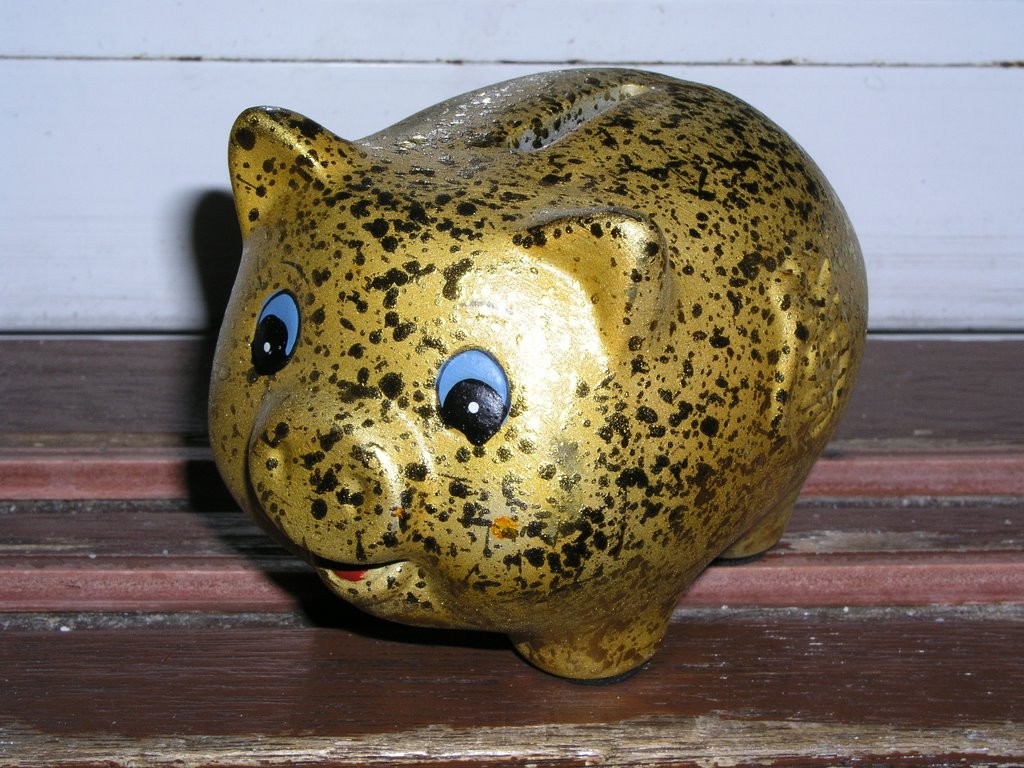 The Year of the Pig is upon us. Not just any Year of the Pig, but the Year of the Red Pig. And not just any Year of the Red Pig, but the Year of the Golden Pig. Possibly. It seems the Year of the Golden Pig rolls around every 600 years. It's an especially auspicious year to be born in. Trouble is, people can't quite remember when the last Year of the Golden Pig was. So some people have decided that this is the Year of the Golden Pig. Which basically means golden piggy banks are the in thing. Here's the one I got with my last box of cereal.
The New Year's festivities in Korea are rather dull. Everyone goes off to visit their families. There are no big parades or fireworks displays. The only good thing about it is that it's three days long. But this year, two of those days are on the weekend.
One Korean tradition is to eat Teok-guk, which is rice stick soup. The rice sticks are just concentrated rice, formed into little sticks. Once you eat the rice stick soup, you get a year older.
Saturday, December 2, 2006
The bang
The bang (방), or room, is one of the crucial components of life in Korea. Because of Korea's high population density, apartments are usually too small to entertain your friends in. Especially when you still live with your parents at the age of 25. Thus, they have developed the bang. Say you want to hang out with your friends and play computer games. You go to the PC bang. If you want to hang out with your friends and sing songs, you go to the norae bang, or singing room. At the norae bang, you can rent your own private room and sing songs all night long. Both of these are more ubiquitous than grass here in the ROK.
Further more, there is the DVD bang, where you can rent a room and watch movies with your friends. Another bang of note is the jjimjil bang, which is the Korean hot bath and sauna house. This is where you'd go for a nice hot bath (very few apartments have baths) and, of course, the sauna. A final bang, which I've recently discovered, is the nori bang. Not to be confused with the norae bang, the nori bang is the children's playroom. This is where you can take your children, and for a few bucks, they can play inside. Perfect for the young mothers who worry about their kids playing in the street.
As you can see, the apartment is pretty much just a place to sleep. All other social activities take place outside of the home. And the bang is a crucial component to that social activity.
Monday, October 30, 2006
Things you don't see in America
A guy painting his car on the side of the road. Okay, maybe you'll see that in America. 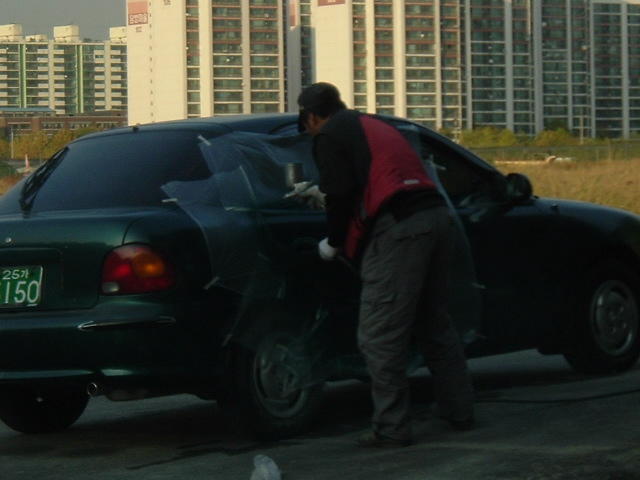
But you'll never see this. A farmer drying his rice in the park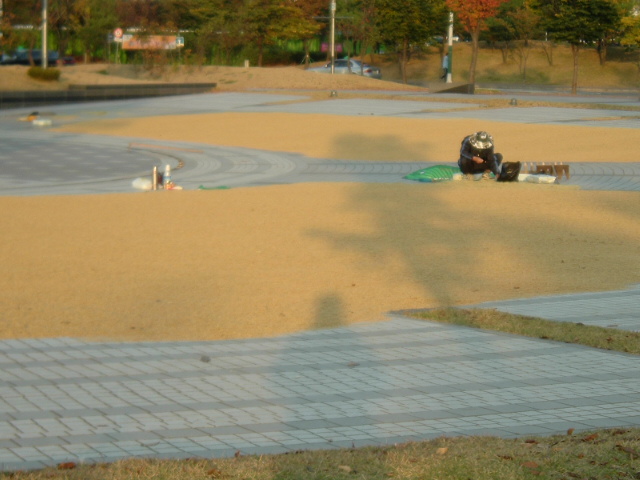
Monday, October 9, 2006
Korean Names 101
Korean names differ from what most people are used to. Instead of using given name and then family name, Koreans express their names as family name and then given name. Why, I'm not exactly sure. I believe it has something to do with the Confucius ethos. The family is more important than the individual. Just as addresses are written from general to specific, i.e. Starting with province, then city, urban area, neighborhood, building, and finally apartment.
Most Koreans outside of Korea adapt their name to the western convention, but a few keep the Korean style. One example would be Kim Jong-Il. He's not Mr. Il, but rather Mr. Kim. His given name is Jong-Il. For the soccer fans out there, you may know Manchester United midfielder Park Ji-Sung. He's not Mr. Sung, but Mr. Park.
Korean names usually have a specific format. But first, a brief explanation of Korean. Korean letters are arranged into patterns that resemble characters. In fact, these characters are composed of a quite limited set of letters. Each "character" represents one syllable. And that brings us back to Korean names. Family names are almost always one character. Kim, Lee, and Park being the most popular. In fact these three last names represent almost half of all Koreans. Within each family name, there are various clans. So people with the same name are only considered related if they are from the same clan. In fact, it was considered taboo to marry anyone within your own clan, no matter how distantly related. Although I've heard that restriction is being lessened. Everyone from the clan (or maybe it's just males) is entered into their family registry. Thus researching your ancestory is quite easy. Many of the clans can trace their ancestors back to the 1300s or earlier.
Next we have the given names. The given names are usually two characters or syllables, although I do have one student with just a one syllable given name. Some families still use a generational name, which is one syllable used with all children of that generation. For example, I have a brother and sister named Jin-Young and Ha-Young. But based upon my limited experience with my students, that isn't very frequent.
The greatest complication is the preponderance of similar names. The Kim, Lee, and Park problem is just the beginning. For some reason, almost everyone has one 'S' or 'J' syllable in their given name. Among 30 or so students and staff at my school, I can only count a handful without a 'S' or 'J' syllable. Permutations of 'S' syllables include Soo, So, Seo, Seh, Seul, Sun, Sung, Seung, and Sang. Among the 'J's, we have Jun, Joon, Jin, Ji, Jung, and Jae. Unfortunately, we don't give our kids Western names, so I'm constantly calling them by the wrong name or spelling their name wrong. And of course, they get upset when I misspell Seo as So.
One final point is the romanization of Korean names. Since Korean sounds don't exactly match English sounds, there is some debate as to how to romanize Korean. For example, the letter ㄱ (I'm not sure if Korean characters will show up on your computer or not) is pronounced somewhere between a hard 'g' and 'k'. In part, depending on where in the word it lies. So the name 김, which is almost always written as Kim, is closer to Gim. The name 박, or Park, should be written as Bak. And finally, 이, or Lee, is actually just a long e sound. So people with the same Korean name can romanize their names differently.
Friday, August 25, 2006
Birthday Bonanza
Today, we celebrated four birthdays at our school. Three from today, and one from Sunday. Quite a convergence for a school with only 25 students. The best part was seeing Korean culture in action.
First, Korean age must be explained. As in China (I believe), a child is born and assumes the age of one. At the Lunar New Year, they again age another year. So a child born at the end of the lunar year would end up being 2 years old pretty quickly. So like horses, all people age a year at the same time - on the Lunar New Year. So while we celebrated their western birthday, they actually don't age according to their Korean age. But on to the celebrations.
The first birthday celebration was for two of our pre-schoolers. Actually one pre-schooler and one kindergartner. But Koreans don't start public school until the first grade. The crucial point came when presents were passed out. It's considered rude (at least by some Koreans) to open presents in front of the giver. So while presents were passed out, none were opened. Just passed out and saved for later. After lunch, we went back to class, where I gave my (unwrapped) presents to my kids. I bought a bunch of stickers when I was in Taiwan, and I figured this was as good as time as any to pass them out. So I let the birthday boy and girl pick out a sheet of stickers. As I somewhat expected, the boy, who is 6 in Korean years (turning 5 in western age), picked a sheet of dinosaur stickers. Originally he thought he just got one sticker, so he was quite happy to get the whole sheet of them. And the first thing he did with them was to let the three other 6 years olds pick out a sticker for themselves. He's such a sweet little boy, and it was nice to see him sharing so well. I struggle with him daily to pay attention to the lesson, and with two new students coming next week, I'm pretty much resigned to letting him plug away at his coloring. At least he can keep himself occupied and doesn't cause problems for the other students.
The second celebration was for a couple of soon-to-be fourth graders. I've eaten with Koreans numerous times, but it's usually Korean food. When you delve into eating Western food with Koreans, it's like entering a whole new world.
First, they don't use knives. They use scissors. It's strange enough when they cut the meat at a Korean restaurant with scissors. It's down right freaky when they cut chicken or pizza with a pair of scissors.
Second, is the pickles. Next to the cabbage kimchi, the pickle is the most frequently appearing side dish. I detest both. I like cabbage. I like pickles. I like spicy food. But the Koreans somehow decided to make spicy cabbage and pickles which leave something to be desired. So while the pizza places always include pickles with my pizzas, I've never felt the need to add them to my pizza. Koreans feel otherwise. They love the side pickle, and make good use of it. Maybe I should bring all of my left over side pickle packets into school for the kids.
And finally, the all important chopsticks. Most Korean utensil sets include a pair of chopsticks and a spoon (for the omnipresent soup side dish). Again, it's not unexpected to see people eating Korean food with chopsticks. I use chopsicks whenever I eat Korean food. But to see kids using chopsticks to eat fried chicken is, well, just unsettling. At least they ate the pizza with their hands.
As the sites and sounds become mundane to me, I'm hoping to post more about Korean culture. Next up - Korean names, and why Americans get them all wrong.
Subscribe to:
Posts (Atom)

